Author: Rob

Throw away your mask

Just kidding, don’t do that yet. Interesting but also not surprising that masks and staying remote has led to me not getting sick at all this year. Even with CDC guidance pointing in the other direction, I’m not entirely sure I’ll fully ditch masks; at least, not on public transit or around people who have kids.

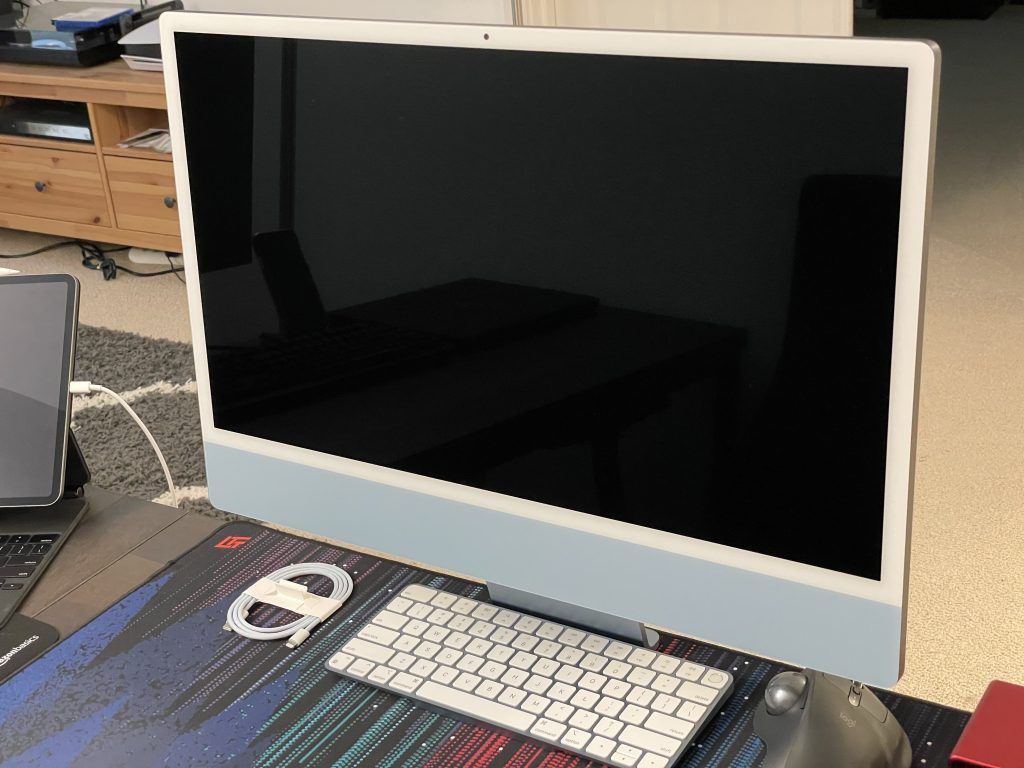
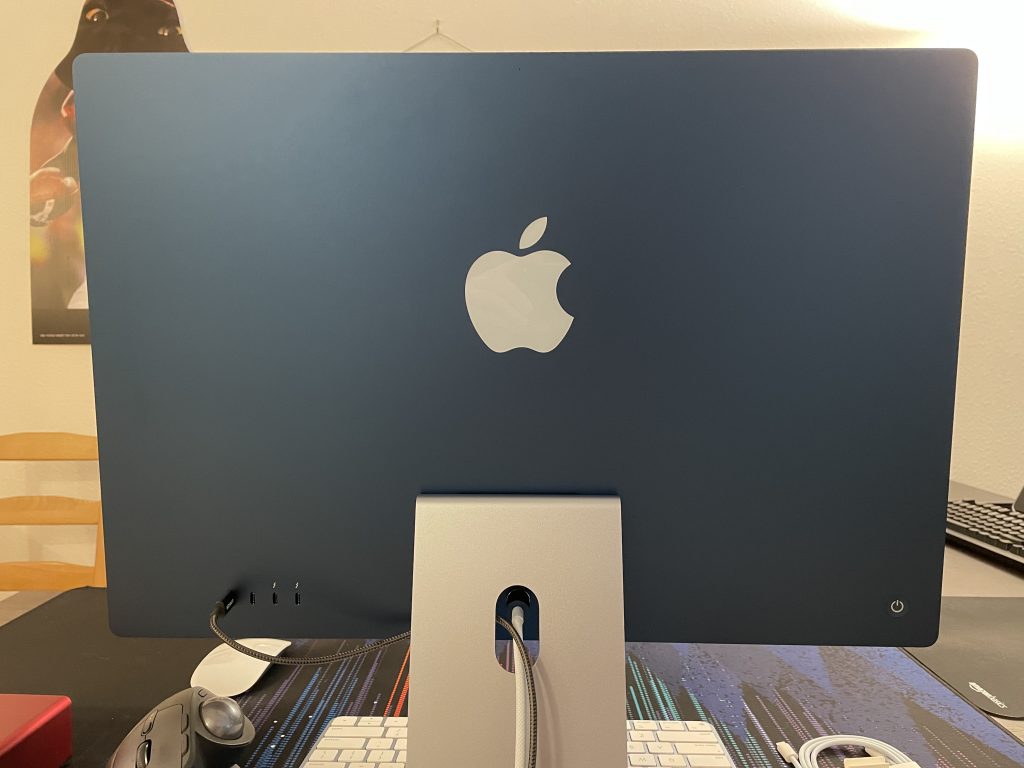
I picked up one of the new iMacs yesterday. It’s very blue. At least, the back of it is. The front of it is more of a pastel blue with a white bezel, which has a completely different vibe. I don’t hate it, but if there was an option for a darker blue all the way around, I might go with that next time.

I went for the mid-range configuration, as I usually do. Go for the spec boosts from additional GPU, RAM, and IO, but leave the storage upgrades behind. Those tend to be expensive for what you get, and I simply don’t use bulk storage locally anymore.

Early impression is that the system is quite capable at doing what I need it to do. The speakers sound pretty good, considering the entire thing is as thin as it is. Better than what you get on an iPad or on most laptops. The screen’s nice, as they usually are. I don’t frequently use Windows 10 with a display larger than 1080p, but my experience has been that MacOS handles 4K-and-higher displays much more uniformly. (That’s to say nothing of the absolute circus that Windows 10 itself is; why, after six years, are some settings still in the Control Panel and others in the Settings app?)

Included in the box were a keyboard and mouse that matched the color of the computer itself. I can take or leave a Magic Mouse – I don’t particularly get a lot of use out of the touch-sensitive surface, and having the charging port underneath the mouse so you can’t charge it and use it as the same time is a pants-on-head-stupid idea that I wish Apple would fix. But the keyboard is nice; it’s comfortable to type on, and it includes a Touch ID button for faster authentication. One of these years, Apple will ship Macs with FaceID to bring MacOS to parity with Windows Hello, but it doesn’t seem like it’s high on their list of priorities.

The translation layer Apple provides to support x86 applications on the new M1 chip is actually pretty crazy. When you try to run an x86 app for the first time, MacOS downloads Rosetta and then uses that to recompile the x86 app to run on the M1 chip. Considering this was a wholesale CPU architecture change, I expected there to be hiccups among the stuff I use, but there simply haven’t been.

As I mentioned in a previous post, I occasionally play Rocksmith. The Mac build distributed via Steam works perfectly fine on M1, and although I’m usually focusing on other things when I’m playing (like staring at the fretboard of my bass), I’m hard-pressed to notice performance issues with the graphics, stuttering audio, etc. – the game simply runs as if it was targeted for the new platform to begin with.

I haven’t tried any other games yet. I’d expect the Good Old Games distro of SimCity 2000 that I still occasionally play to work fine. Supposedly Final Fantasy 14 is serviceable as well. However, I’m currently struggling to come up with a reason to play that on the Mac when the PS5 is in the same room, giving me much better hardware and a much larger screen to play on.

Long story short, Apple did a good job with building a complete package that serves the purposes they think they need to serve, and it seems clear to me that the tight integration and focused set of use cases are things that will be to their advantage for quite some time.

Windows (and Linux, to be sure) are designed to play to broader sets of hardware configs based on general-purpose components. Fifteen years ago, I would have identified the lack of AAA-level PC gaming as a weakness for the Mac platform; but then again, if I’m doing all my gaming on consoles and not even maintaining a PC for PC gaming, do I care? Probably not, right? Eliminating that checkbox from the list of things I need a computer I buy to support means I can look at other options that can potentially serve other purposes even more effectively.

And the bonus is I don’t have to subject myself to the vagaries of the interplay between an operating system I don’t particularly like and the sheer number of hardware configurations it needs to support.

If only 2003 me could see me today…

Leave a Comment

Final Fantasy 14’s raids

Another Final Fantasy 14 post for this weekend.

Recently I’ve been getting caught up on the 24-person raid content in the latest expansion. It still amazes/amuses me that raids of this size are so easy to put together in this game. I recall us struggling to get 20 people together for Zul’Gurub raids in World of Warcraft years ago. The mindset seemed to be that you wanted to only raid with people in your guild or in allied guilds, and if you couldn’t cobble together your four groups, you had to spam general chat in the hub towns to pick up random players to fill the gaps. Finding a taker was difficult enough sometimes, and became even more difficult if you needed something that was in higher demand like a tank or a healer.

If memory serves, one of the problems involved with taking random players were that guilds usually had points systems to allocate loot to members over time, and strangers simply don’t fit into that system. If you’re a stranger, either you get preferential treatment as an enticement to join, which is unfair to 95% of the raid who have spent weeks or even months accumulating loot points, or you get nothing at all, which is unfair to you.

The other big problem is that each side is taking a gamble on the skill level of the other. A seasoned raider whose group has the night off would likely be bored with an inexperienced group that hasn’t (or simply can’t) clear things; and an experienced group would be slowed down by taking on a stranger who they have to train. It rarely works out for either side unless there is a mutual investment of time and training in each other.

Working with random players was considered the last resort; and yet, in Final Fantasy 14, everything except the absolute hardest content can be easily accomplished via matchmaking. It seems to me that Square-Enix was essentially able to solve both of the problems described above.

All loot is rolled on equitably (with players participating in the role a drop is designed for receiving higher priority), and in newer content, loot tends to be restricted to one drop a week to prevent players from hoarding the latest and greatest things.

At the high end, drops are even more restrictive – but with just eight people in a group at that tier, it’s much easier to manage getting a consistent group together.

In terms of encounter difficulty, the game tells you, one way or another, everything that’s coming at you – whether it’s an area attack, something your group needs to stack up or split apart for, there are different markers for everything. It’s always been explained as your character having been possessed with the ability to see a brief glimpse into the future. The markers usually display for 3-5 seconds, which actually makes it quite easy to “sight read” new encounters so players have a chance to complete something on their first attempt without spending the entire time face-down. All you have to do is pay attention and be ready to run.

On extremely rare occasions though, this ability just wouldn’t manifest itself and you’d have to read the boss directly to understand what was coming. It’s usually pretty obvious though, like the boss facing one way and raising an arm in the air with the intent to swing in a wide arc directly in front of it.

It seems like the raid content in FF14 has moved towards a middle ground between those two over the years; early on the markers were obvious and would last for quite some time, but as the player base has gradually become more experienced over time, markers in newer content tend to last for maybe a second, so you need to read the boss to understand what’s coming. What this means is that instead of serving as a warning, the markers serve as an educational tool for the newbies (“this is the range of this attack so you know for next time”) or a reminder for others (“this is what you missed”). This means you have to pay far more attention than before, which makes these raids quite exhausting the first few times you do them. But as with all things, once you understand the tells, it gets easier.

And as I’ve mentioned in a previous post, as the healer, getting more familiar with this stuff means I can allocate more bandwidth to helping others recover when they don’t do something correctly.

Here’s gameplay of The Tower at Paradigm’s Breach.

Leave a Comment

The more things change, the more they stay the same

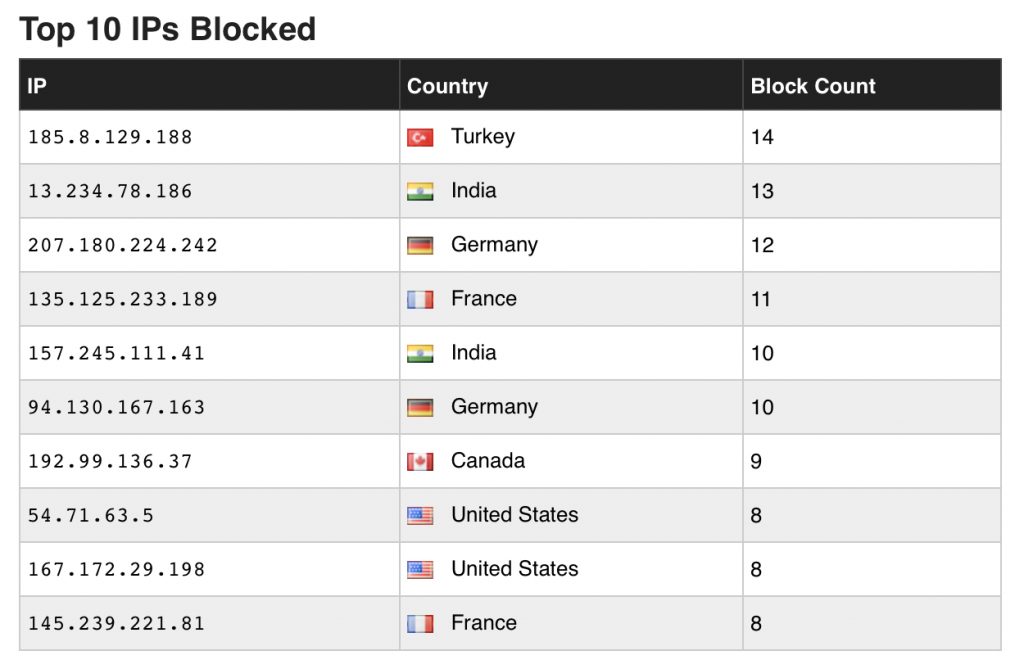
I’ve been fine-tuning things on the site for the last couple weeks, particularly security-related stuff as WordPress remains under constant threat of l33t h4x0rs. Here’s a screenshot from a recent report of attempted activity on the site:

Could you not?

I found this to be kind of amusing – Turkey’s at the top of the list, and when this site was hacked back in late 2009-early 2010, the person who defaced it put up some text that was in Turkish. Not saying it’s the same person now, because it probably isn’t; just a funny coincidence.

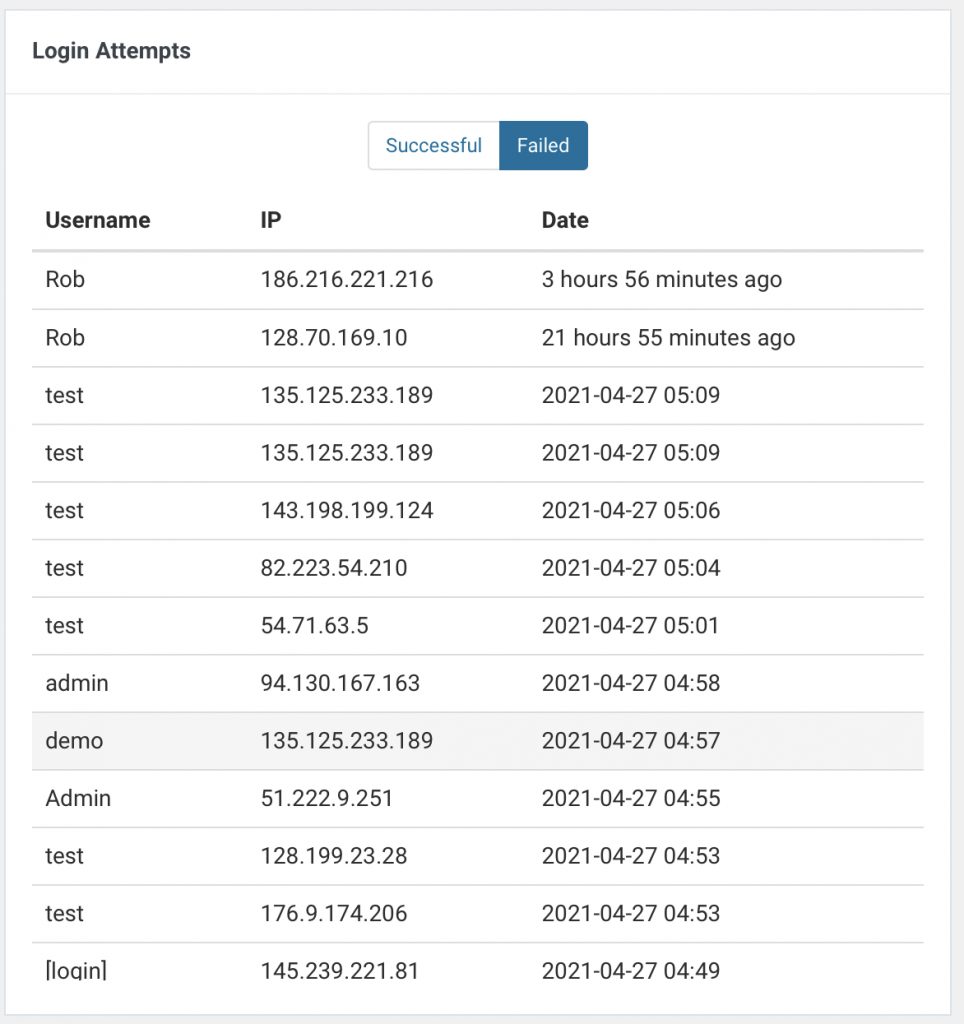
Another thing the security software is reporting is all the failed login attempts:

Keep guessing, guys

The interesting thing about these logs is that they show what people are trying, and I’m going to hazard a guess that people try these because they’ve worked in the past. So that should be a clear warning not to use usernames like Admin, demo, test, or whatever name your posts publicly show as having been written by. (The attempts using my name are interesting in that they only just started today, even though all the posts on this site since the revival nearly two months ago have been under the same name.)

Of course, having 2FA is more important than obscuring your username; even if the username gets out, without the security token, you aren’t getting in via the front door anyway.

This place isn’t exactly Fort Knox either though; I’m sure WordPress has a vulnerability in some spot or another that someone can take advantage of. In that event, I’ll just have to make sure the database is backed up. It won’t do to have to put this site back together again.

Leave a Comment

Don’t stand in the red stuff

Small Final Fantasy 14 update this weekend. I’m starting to get caught back up on all the stuff that’s happened over the last year and a half. The main story is caught up, the normal raids are cleared, the normal trials content are almost cleared. I haven’t touched alliance raids yet, but plan to do so before too much longer. Word has it that they’re based on Nier: Automata, which I enjoyed the hell out of back in 2017.

Come to think of it, 2017 was an interesting year all around – Persona 5, Nier: Automata, the Stormblood expansion (although in hindsight it seems to have been less well-received than Heavensward or Shadowbringers), Breath of the Wild were all worthwhile time investments. Went back to Japan for the first time in seven years; had a mini-college reunion for a few weeks over the summer with one of the Australians; found my footing at the job I’d taken after moving out here, which I’m still at five years later. Sometimes everything just hits on all cylinders, right?

Anyways, here’s some more gameplay footage. The nice thing about being late to the content is that the player base is largely already familiar with everything, so I can focus more on studying the environment and the patterns and less on scrambling to keep people vertical. That’s quite a contrast to the last video I posted where I mentioned I literally had to save the attempt myself. Not that I don’t mind being ahead of the curve, but sometimes half a workload is better than a full workload. The interesting thing about this encounter is that the boss actually stores attacks up for execution a minute or two later while also running through everything else it’s going to run through. I’m continually impressed/amused that Square-Enix has been able to keep churning out interesting ideas for raid content after all these years.

One more note about this video; it seems the PS5 records things at 1080p and 60FPS. The quality is quite nice, I like it.

Leave a Comment

Like riding a bike

I’m back to playing Final Fantasy 14 again after over a year and a half off. When I quit (again) back in October-ish of 2019, Shadowbringers was still fairly fresh – a lot of folks were still making their way through the main scenario, and the more hardcore were working on the harder raid content. I found myself in the latter camp, working with a group of folks out on the east coast a couple nights a week. We had made our way through the first raid after about a month of trying, but a confluence of people getting busy with school or running for their lives ahead of Tropical Storm Imelda along with my workload spiking caused both the raid group to have to go on hold and for me to have to quit altogether.

The raids themselves are quite fun, and even in the normal difficulty mode tuned for the player base at large, they can be quite challenging. I saved a video replay of the first time I cleared the fourth encounter –

I’d saved the video partly because it was my first clear of the raid content that released with Shadowbringers, but also partly because I’d figured out the dance routine just well enough to be able to save the raid from a wipe at about the mid-point. Common wisdom about the use of limit breaks in the game seems to be – usually you want the DPS to have it, and there may be specific events which require the tank to use the limit break instead, but if a healer has to use it, that usually means the attempt was destined to fail and the healer just prolonged the inevitable. So this was a fairly unique set of circumstances to have happen all at once.

Over the last 8-or-so years that I’ve played this game, I’ve gone into raids as a DPS, as a tank, and as a healer. Healing seems to be uniquely challenging in that not only do you have to dodge all the same stuff that everyone else has to dodge, but you also have eight health bars to watch, you have to be aware of when the heavy damage is incoming (both the things that are raid-wide and the things that are focused on one or both tanks), and you still have to pitch in on damage dealing when there’s nothing else going on.

Then once you have all of those things figured out, you start optimizing. Do you need to drop a huge raid-wide heal just because everybody’s at 85% health, or ignore it and let them recover on their own? Do you have to stop and heal the tank through a tankbuster, or can you throw an instant-cast shield and trust that they’ll mitigate the rest of the damage themselves while you continue throwing out damage?

In the harder difficulty content (which the above is not), you go so far as assigning healers to tanks, giving people specific spots to stand, and building up internal rhythms that you follow rather than playing a more read-and-react style. You know when the encounter starts you can cast four damage spells before the first big tankbuster comes in, then the team has to fan out and you have to stand on this particular square, and so on. The penalty for not doing the right thing or not healing the right person at the right time is stiffened too; a boss that doesn’t get downed in 10-12 minutes tends to start throwing out massive raid-wide damage as punishment for taking too much time, so if too many people have too much downtime on the DPS charts, the chances for failure skyrockets.

Anyway, it’s a lot to think about, and the worst part is there are 7 other actual people involved. So you can imagine that having this many buttons to press, and needing such detailed knowledge of encounters, and knowing that the penalty for not doing your particular job is that other players’ characters take a dirt nap, there’s a lot of stress and anxiety around getting back into shape and being able to play again if you’ve taken any measurable amount of time off. Maybe the worst part is that the game doesn’t store your hotbar assignments on the server, so you come back to the game with an empty hotbar and need to rely on muscle memory kicking in before you can get your act completely together again.

Thankfully, one of the new features in the Shadowbringers expansion was the ability to run dungeons with AI counterparts. Seems to defeat the purpose of an MMO to offer single-player modes, and the playing the game this way is definitely a lot slower than playing with other humans who have optimized their play styles, but it does give a low-stakes way to figure things out again. After about a day of playing with the bots, I had my hotbar sorted back out, and in comparing my new hotbar to what I had in the video above, the results were nearly the same. Leading up to Shadowbringers, the recovery time was closer to three or four days.

Square-Enix is on about a two-year cadence with Final Fantasy 14 expansions; that is to say, they’ll release an expansion, then spend the next two years releasing periodic content updates/additions before releasing the next expansion. We’re at the tail end of the Shadowbringers expansion now, with Endwalker (the next expansion’s title) slated for release in just a few months. So since I stopped playing shortly after Shadowbringers came out, that means I have roughly two years’ worth of content to get caught up on in the next four or five months. Should be doable, but this is going to wreak havoc on my backlog. I was a portion of the way through Yakuza 5 (itself part of an endeavor to play through the entire Yakuza series), and I had a handful of titles that were on the radar for immediate playthroughs after that, and now everything’s on hold. Oops.

Leave a Comment